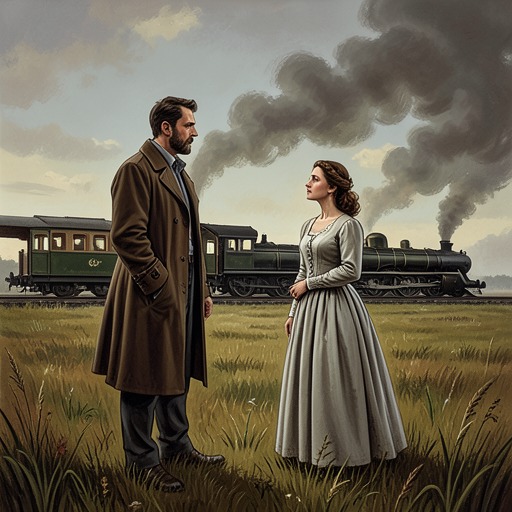
Dorrigo and Amy Cross Paths on Sydney Harbour Bridge
The Narrow Road to the Deep NorthDorrigo and Amy Cross Paths on Sydney Harbour Bridge is a missed reunion in which recognition arrives too late to become contact. Dorrigo Evans sees Amy Mulvaney approaching across the bridge, knows that his old love is alive, and hesitates between calling out and letting her pass. They cross without speaking. Only after she has disappeared does he turn back, understanding that the life he thought lost had continued without him, and that his own failure to act has made their separation final.
Setting and Approach
The encounter follows a day of emotional disorientation. After Tom Evans has told him something that leaves him needing to come to terms with the news, Dorrigo leaves the hospital and follows his own advice to walk. Sydney is sweltering and crowded with American servicemen on leave from Vietnam. He walks to Circular Quay, then across the Sydney Harbour Bridge, intending to visit a surgeon friend in Kirribilli. The walk initially offers relief: the bridge’s broad path and expansive views let him lose himself among the sightseers and feel reassured by the city below.
Midway across, the scene slows around the changing light and Dorrigo’s act of looking. A cooling easterly moves over the water, where the waves break into white and blue below him. Ochre-red tower cranes stand near the unfinished opera house, whose open framework recalls the fine veins of dry gum leaves. The late sun divides the city into bright and shadowed bands. When Dorrigo straightens from the railing and resumes walking, a woman briefly emerges from darkness into light. The bridge’s geometry makes her appearance gradual: she vanishes, reappears beneath the sandstone arch at its northern end, then comes nearer through the moving crowd.
Recognition and Hesitation
At first Dorrigo experiences the approaching woman as almost ghostlike. He watches her across the crowded walkway, separated from her by the bridge’s ironwork and the traffic noise. When he sees her clearly, she is wearing sunglasses and a sleeveless dark-blue dress with a white band at the hips. Two small girls hold her hands; they laugh and chatter, and she replies. Dorrigo cannot hear their words, but the ordinary exchange confirms that she is not an apparition. He had believed Amy dead. Now, more than a quarter-century after first seeing her in an Adelaide bookshop, he recognizes her as older but, in his eyes, more beautiful for the person time has revealed.
The recognition restores feelings he had assumed were gone. The historical distance between them—the wars, inventions, and public upheavals of the intervening years—seems suddenly powerless beside the particular person walking toward him. As Amy draws nearer, Dorrigo’s attention fixes on her physical details: her bleached hair, the lines of her face, the small mole above her lip. He sees that she wears a necklace, and its sparkle releases an uncontrollable rush of memory. His perception shifts from judging whether age has preserved her beauty to the simpler, more urgent knowledge that he wants her.
That certainty does not settle what he should do. He considers stopping or walking on, calling out or remaining silent. The children’s resemblance to Amy makes her present life unmistakable, while their features also bear something that pains him because it is not hers. He wonders whether she is happy in her marriage and recognizes that barging into her life could cause chaos; almost at once, he argues inwardly that they might still begin again. His body registers the conflict as he approaches: he struggles to breathe, his stomach churns, and his balance falters. The decision is compressed into the few steps that remain between them.
The Crossing and Its Aftermath
As Amy comes close, Dorrigo slows, but his mind races. He means to call out. In the full light behind her, he sees her pinch her dress between thumb and forefinger and tug it back up at the cleavage. For an instant, he imagines that she might welcome him back into her arms and life. The expectation breaks against what happens: they walk past one another without a word. Dorrigo remains in the bridge’s shadow and keeps looking straight ahead. He does not turn around, call to her, or run back. At the far end, he finally finds the strength to turn, but Amy is gone.
The missed encounter changes the meaning of the past for him. Dorrigo had believed Amy dead; in the shock of passing her, he thinks he has got her, himself, their love, and time wrong. He imagines that he should have stopped her, and knows that he now cannot. People continue to stream around him, reducing him to an obstruction among the bridge’s everyday objects and bodies. His thought of Lot’s wife reverses the story’s lesson: in his understanding, the danger is not looking back, but failing to do so when the chance still exists. The moment leaves him suspended between the choice he did not make and the possibility that life may sweep people together and apart without offering a clear choice at all.
He remains among the bridge’s iron spans, roaring traffic, blue sky, and sparkling water, diminished by the scale and movement around him. He thinks, "How empty is the world when you lose the one you love." Then he turns back and continues walking, without a path that can take him back to the meeting. His final recognition is not that Amy has died, but that she has lived while he has been inwardly dead to the life she continued.
Amy’s Separate Understanding
The narrative also shows the encounter from the consequence that Dorrigo cannot see. After crossing the bridge, Amy buys ice creams for her two nieces at Circular Quay and takes the ferry back to her sister’s home in Manly. For many years she has believed Dorrigo died. Only recently has she learned otherwise, as his public fame has grown. On the ferry and later at home, she asks herself why he never returned to find her if he was alive. Exhausted, she lies down still asking why; she cannot forgive him for breaking his promise.
The two are therefore separated not only by the silence on the bridge but by incompatible histories of waiting. Dorrigo has thought Amy dead; Amy has thought Dorrigo dead, and, after learning he survived, interprets his absence as a broken promise. The scene gives neither of them access to the other’s immediate understanding. Its tragedy lies in the gap between recognition and communication: Dorrigo sees the person he longs for but does not stop her, while Amy leaves the bridge without knowing he was there. Their brief passage through one another’s lives turns the possibility of reunion into another lasting absence.